The UK tax authority has published its full e-invoicing roadmap: mandatory VAT e-invoices from 1 April 2029, built on the Peppol network. It is the longest runway yet in the global mandate wave — and the clearest signal that structured invoices are becoming the default everywhere.
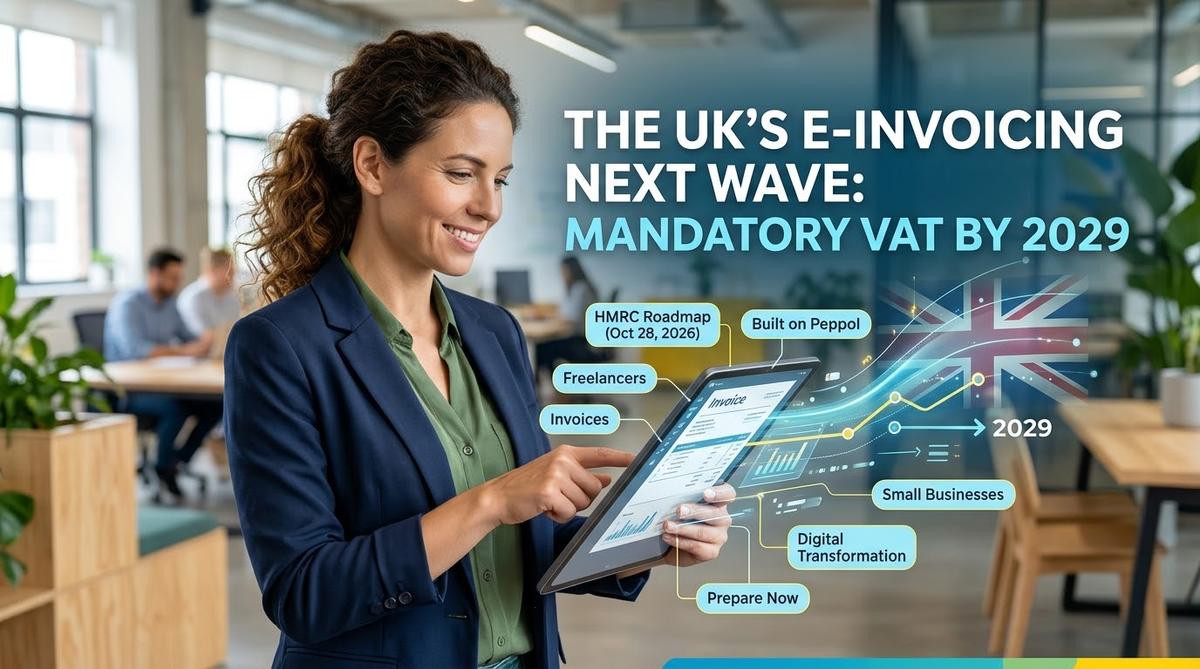
On 28 October 2026, the UK's tax authority, HM Revenue & Customs (HMRC), published its roadmap for mandatory e-invoicing, released alongside the Autumn Budget. From 1 April 2029, VAT-registered persons — including public bodies — must be able to issue and receive VAT invoices as e-invoices, unless a specific exemption applies. Full requirements will be confirmed between October 2027 and April 2028, giving businesses at least 12 months to prepare.
This is not a UK-only story. It is the latest chapter in the worldwide shift we have been tracking here: France is already live, Spain has set its dates, Slovakia's mandate starts on 1 January 2027, and the UAE's phased rollout runs through July 2027. See E-Invoicing Is Going Mandatory: The 2026–2028 Deadlines You Need to Know and our follow-up on the UAE's deadlines and monthly fines. The UK announcement matters because it adds a major tax system to the same direction of travel — with the longest runway yet.
Two things were settled. First, the date: 1 April 2029 for mandatory VAT e-invoices, announced at Budget 2025 and now confirmed in a detailed implementation roadmap. Second, the plumbing: the UK will adopt Peppol as its core interoperability framework, with businesses generally connecting through certified Access Points offered by their software providers. HMRC itself will become the UK Peppol Authority, but it will not receive copies of ordinary business-to-business VAT invoices.
The roadmap also draws a hard line every freelancer should understand: an e-invoice is structured invoice data exchanged directly between buyers' and suppliers' financial systems. A PDF, JPEG, HTML page or fax image does not qualify, however neatly formatted it is. That distinction is now the same in country after country.
| When | What happens |
|---|---|
| Spring 2027 | Public technical consultation on e-invoicing standards and Access Point certification |
| October 2027 – April 2028 | Full requirements published: scope, exclusions, standards, guidance, business identifiers and software-provider rules |
| Summer 2028 | Readiness testing with software providers |
| Winter 2028 | Infrastructure and governance arrangements operational |
| 1 April 2029 | Mandatory VAT e-invoicing takes effect |
The requirement will apply broadly to VAT-registered businesses, sole traders, partnerships, charities and public bodies, and it covers taxable supplies between VAT-registered persons within the UK where a VAT invoice is already required. Exemptions will be tightly limited, mainly for digitally excluded persons. Details are due by April 2028.
Just as important is what stays outside the mandate: sales to consumers, supplies by non-VAT-registered businesses, and cross-border transactions are not required to be e-invoices, though anyone may adopt the format voluntarily. So a freelancer who is not VAT-registered, or who invoices consumers, is not caught by the 2029 date — but if you invoice VAT-registered UK clients, this roadmap is your calendar.
HMRC's case is not really about tax forms. It is about getting paid. Late payments cost the UK economy £11 billion a year, the roadmap says, and small businesses spend an average of 86 hours a year chasing them. Poor information flow is a major reason invoices are paid late: an invoice that arrives incomplete, incorrect, or in the wrong inbox gets delayed, and both sides pay for the extra work.
The numbers HMRC cites for the fix are striking. Industry research suggests the smallest businesses could save five hours and 40 minutes a week through e-invoicing, and NHS Shared Business Services reports that electronic invoices are paid 26 days faster than paper or email invoices. E-invoicing can also cut fraud, for example by automatically checking bank details against those previously used by the same supplier. Clear payment terms still matter, as we explained in Invoice Payment Terms Explained: Net 30, Net 15, Due on Receipt — but a structured invoice removes the most common excuses for delay.
Even if you never invoice a UK client, the UK roadmap tells you three things. First, the direction is settled: major economies are converging on structured data, not document attachments, and Peppol is emerging as the shared network that lets different software talk to each other. Second, the transition is being given years, not months — so the smart move is to fix your invoicing habits now, while there is no deadline pressure. Third, the cost argument is weakening: HMRC notes that many small and medium businesses will not need new software, because several providers plan to include e-invoicing in their existing packages at no extra cost.
For freelancers, the practical lesson is about data quality. An e-invoice system can only automate what your invoice already states clearly: who you are, who the client is, what was supplied, the amount, the tax, and the payment details.
As with the UAE mandate, honesty matters. BillsZilla's free invoice generator produces a correct, professional invoice — the right fields, tax calculations and a clean PDF your client can read — and it is a good way to standardise your invoicing today. What it does not do is send a structured e-invoice through a certified Peppol Access Point: that needs compliant software and the framework to be finalised in 2027–2028. Use BillsZilla to get your invoicing right now, and compliant software to meet a mandate when it reaches you. A perfectly formatted PDF is not an e-invoice.
Sources: HMRC — Roadmap for e-invoicing implementation (GOV.UK), Regfollower — UK: HMRC publishes roadmap for mandatory VAT e-invoicing.
